
The Marble Hill community in the Bronx is the only part of Manhattan connected to the mainland, due to a little-known quirk of geography. Originally, this 42-acre enclave was the northernmost section of the borough of Manhattan and was surrounded by the winding Spuyten Duyvil Creek.
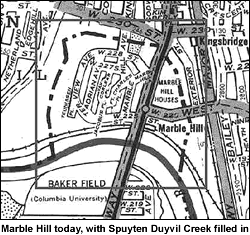 In 1895 the course of the Spuyten Duyvil Creek was changed to improve navigation around Manhattan, thus physically separating Marble Hill from Manhattan. For 19 years it remained as an artificial island until the ground that was removed to make way for the new course of the creek was used as landfill for the former course of the stream.
The name of Marble Hill was conceived by Darius C. Crosby in 1891 from the local deposits of dolomite marble, which is a relatively soft rock that overlay the Inwood and Marble Hill communities. The marble was quarried for the Federal buildings in lower Manhattan when New York was the Capital of the United States in the 1780s.
Historically speaking, Marble Hill has been occupied since the Dutch colonial period. On August 18, 1646, Governor Kieft signed a land grant to Mattius Jansen van Keulan and Huyck Aertsen. This grant had comprised the whole of the present community. Johannes Verveelen petitioned the Harlem authorities to move his ferry from what is now the East River and 125th Street to the Spuyten Duyvil Creek because the creek was shallow enough to wade across, thus evading paying the toll. The ferry charter was granted in 1669.
Teunissen Place was named for Tobias Teunissen, a wool washer from Leyden, Holland, who came to the area in 1636. He applied and received a land grant to live in Inwood near 213th Street. Occasionally he had worked on the De La Montagne farm, which was located in what is now the Harlem section of Manhattan. Teunissen was killed in an Indian raid in 1655, and his wife and child were held hostage until they were ransomed by the Dutch authorities. The Dyckmans and the Nagles, who owned land in Inwood, purchased the Teunissen property in 1677.
Two bridges connected Marble Hill with the mainland. These were the Kingsbridge, constructed in 1693 by Frederick Philipse, and the Dyckman Bridge, constructed in 1759 by Jacobus Dyckman and Benjamin Palmer. The Kingsbridge was built as a toll bridge under Royal Charter for Frederick Phillipse. The Dyckman Bridge was constructed as a toll-free bridge for the farmers who refused to pay the toll. Both bridges have been covered over with landfill. At 210 West 230th Street on the southwest corner of Broadway and 230th is a plaque designating the area as the site of the Kings Bridge. The Dyckman Free Bridge is located on the grounds of the Marble Hill Houses.
One of the local visiting spots during this period was a tavern operated by the Dyckman family. They had a tavern called the Black Horse Inn, located near McGown’s Pass in what is now Central Park. The Dyckmans sold the Black Horse to finance a new operation on the west side of Broadway and 226th Street that was to be managed by Benjamin Palmer, who owned property on City Island. It was situated to cater to the traffic from both bridges. In 1772 the Dyckmans sold the tavern to Caleb Hyatt and was known by the new owner’s name as Hyatt’s Tavern at the Free Bridge.
When hostilities broke out at the start of the American Revolution, the Continental Army constructed a fort on Marble Hill as part of a series of forts to defend the area. By November of 1776, the fort had been taken over by Hessian forces and re-named Fort Prince Charles in honor of Charles, Prince of Brunswick, brother-in-law to King George III of England. Despite contrary beliefs, the Kingsbridge and the Dyckman Free Bridge served as escape routes for the retreating American forces after the Battle of Fort Washington on November 16, 1776.
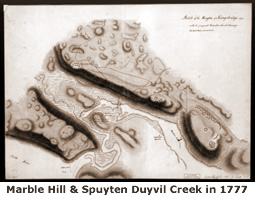 In January 1777, an American attack was made in the Marble Hill area against the Hessian occupiers. This particular raid was under the command of General Heath, which, when the cannons opened up, forced the Hessians to retreat from the tavern to the fort to return fire.
After the war ended, the tavern remained in the Hyatt family until 1807, when it was leased to James Devoe. The building was eventually razed and its successor was the Kingsbridge Hotel, which was located on the east side of Broadway and 226th Street.
The hotel had a mansard roof and a central turret. It catered to the anglers and sportsman who came to the area either by the Hudson River Railroad Company or boat service up the Harlem River. One of the meals served at the hotel was turtle dinner, which became a favorite of the guests. The hotel’s business declined when Broadway was widened and interest was lost in the community. The hotel fell into disrepair and was torn down in 1917.
In 1817 Curtis and John Bolton purchased land in the area. Their home was on the south side of the community and had a mill located 350 East of Broadway on property now owned by Metro North. The Boltons were related to Reginald Bolton, the noted historian of Northern Manhattan.
Saint Stephen’s United Methodist Church has been a fixture of the community for well over a century and a half. It is presently located on 228th Street and Marble Hill Avenue. The church was constructed in 1898 and is the third structure of the same name. This congregation was in existence since 1825 and was incorporated a decade later, making it one of the earliest religious institutions in the area.
One of its pastors was Reverend William Tieck who served the church from 1946 to 1977. Dr. Tieck was well known as the official Bronx County Historian, in which capacity he served from 1989 to 1996. Reverend Tieck authored several books on the Bronx, one of which is called Riverdale, Kingsbridge, Spuyten Duyvil New York City, A Historical Epitome of the Northwest Bronx, published in 1968.
The IRT Subway was extended from 145th Street to 242nd Street and opened in 1906. The station stop for the IRT at Marble Hill is 225th Street. Metro North has a station in Marble Hill. The station was originally located on the east side of Broadway but was renovated and relocated to the west side of Broadway. It is the only station that is located in the Borough of Manhattan, as the rest of the line has stations in the Bronx.
This sparked land speculation in the community, and 6-story apartment houses were constructed. In the early 1950s urban renewal came to the area. A complex was built bounded by Broadway, Exterior Street and 225th Street and was called the Marble Hill Houses. This property was acquired by New York City on August 26, 1948. The houses were completed in 1952. Part of the acquisition was used to become the Marble Hill Playground, which is located on Marble Hill Avenue between 228th and 230th Streets.
On March 11, 1939, Bronx Borough President James J. Lyons took advantage of the border wars that were raging between the Bronx and Manhattan. As a publicity stunt, Lyons planted the Bronx County flag on the rocky promontory at 225th Street and Jacobus Place. Lyons proclaimed Marble Hill as a part of the Bronx and demanded the subservience of its residents to the Bronx.
The response to the incident was met with boos and thumb nosing by 50 residents of Marble Hill. In addition, the residents refused to change their status and wanted to remain loyal residents of Manhattan. Petitions and signatures were gathered to be sent to Governor Herbert Lehman to ensure Marble Hill’s status to remain part of Manhattan. To this day residents of the community who serve on jury duty have to go to lower Manhattan to serve.
John F. Kennedy High School is located in Marble Hill and was opened in the 1970s. Presently, there is a new shopping complex being constructed on the south side of 225th Street between Broadway and Exterior Streets.
A new shopping mall will be the center of attraction for Marble Hill. This mall is located on 225th Street between Broadway and Exterior Street and overlooks the Harlem River. Target and Marshall’s opened on July 25, 2004. There is an Appleby’s Restaurant that will be opening to serve the shoppers of the mall.
Even though it is the landlocked part of Manhattan, Marble Hill still enjoys the privileges enjoyed by the borough. Residents who serve on jury duty are required to go to the courthouses on Center Street in lower Manhattan. The residents enjoy the representation of the offices of City Council District 10 Manhattan as well as the elected officials of Manhattan and the Bronx. Bronx Community Board 8 oversees the day-to-day operations of Marble Hill.

Comments
Posted by: Danielle Maul | July 17, 2005 9:55 AM
Posted by: Usage Ursula | October 4, 2005 12:49 PM
Posted by: Jim Taylor | November 22, 2005 10:08 PM
Posted by: Ed Garcia | March 1, 2006 8:12 PM
Posted by: Nicole Smith | March 21, 2006 11:06 AM
Posted by: Michelle | March 23, 2006 3:14 PM
Posted by: Josh | May 28, 2006 9:48 PM
Posted by: Pete | June 20, 2006 12:15 AM
Posted by: aj | June 26, 2006 1:30 PM
Posted by: Malik | October 3, 2006 2:29 PM
Posted by: Ron Simmons | October 17, 2006 2:11 AM
Posted by: Joe | November 10, 2006 2:46 PM
Posted by: jojo | January 5, 2007 3:33 PM
Posted by: rob the mailman | April 12, 2007 2:22 PM
Posted by: Jessica | June 16, 2007 9:28 AM